

Skip to content
Systems

Ultrafiltration (UF) Systems

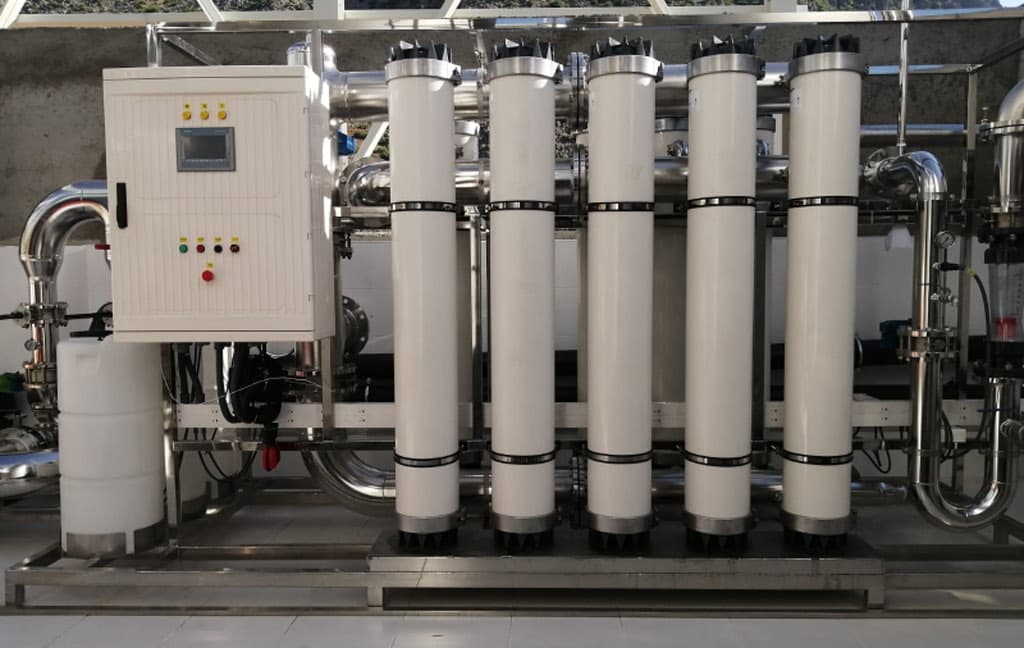
Membrane filtration at low pressure; retains suspended solids, colloids and bacteria without altering the chemistry of the water.

  • Pore size~0.02 µmtypical UF range
  • PressureLowless energy than RO
  • Chlorine toleranceHighunlike an RO membrane
  • DeliverySingle sourcemanufacturing, piping, commissioning

Ultrafiltration passes water through a semi-permeable membrane at low pressure and retains suspended solids, colloids, emulsified oils, metal hydroxides and bacteria. Because it lets dissolved salts through, it does not change the chemical make-up of the water — and that is what separates it from reverse osmosis.

The membrane pore size is typically in the order of 0.02 micron. UF is used under three main headings: pretreatment ahead of reverse osmosis, drinking water production and waste water recovery.

Ultrafiltration (UF) Systems

1 / 2

How it works

Stages

  1. 01

    Coarse filtration

    A screen or disc filter provides upstream retention so coarse particles do not block the module.

  2. 02

    Feed

    Water is taken into the modules at low pressure; energy consumption is markedly lower than with RO.

  3. 03

    Filtration

    Suspended solids, colloids and microorganisms are retained at the membrane surface; the filtrate goes to the process.

  4. 04

    Backwash (BW/CEB)

    The membrane is cleaned by backwash and chemically enhanced backwash; this is the key to uninterrupted operation.

Where it is used

Typical applications

  • RO pretreatment

    Extends RO membrane life by lowering the colloidal load reaching it.

  • Drinking water

    Safe utility water through removal of turbidity and microorganisms.

  • Waste water recovery

    Making returned process water reusable within the plant.

  • Oil–water separation

    Removal of emulsified oils from water.

How is it different from reverse osmosis?

Both are membrane technologies but they do different jobs. Ultrafiltration retains particles and microorganisms and passes dissolved salt — which means it does not lower the conductivity of the water. Reverse osmosis retains dissolved salt too, and therefore demands higher pressure and more energy.

In practice the two work together in most plants: UF stands ahead of the RO and protects the membrane. Which stages are needed is determined by the raw water analysis.

Brands

Brand-independent selection

We select the most suitable product according to the raw water analysis; a brand change is possible on existing systems.

  • Toray
  • DuPont
  • LG
  • Veolia
  • Pentair

Frequently asked questions

Is UF enough on its own?

If your objective is removing turbidity and microorganisms, it usually is. If low conductivity is required, reverse osmosis must follow the UF.

How often is the membrane cleaned?

Backwashing is automatic and frequent; the frequency of chemically enhanced backwash depends on the raw water quality and is set during commissioning.

Can it be added to our existing line?

Yes. We survey the existing system and engineer how the UF stage will be tied into the line.

Send us your raw water analysis and the flow rate you need

Let us size the system together; we will survey the site in person if needed.