

Skip to content
Systems

Demineralization and Mixed Bed Systems

Full demineralization with ion exchange resins; for boilers and processes that require high purity.

  • MethodIon exchangecation + anion + mixed bed
  • RegenerationAcid / causticchemical storage required
  • UsePolishing stagemostly downstream of RO
  • DeliverySingle sourcemanufacturing, piping, commissioning

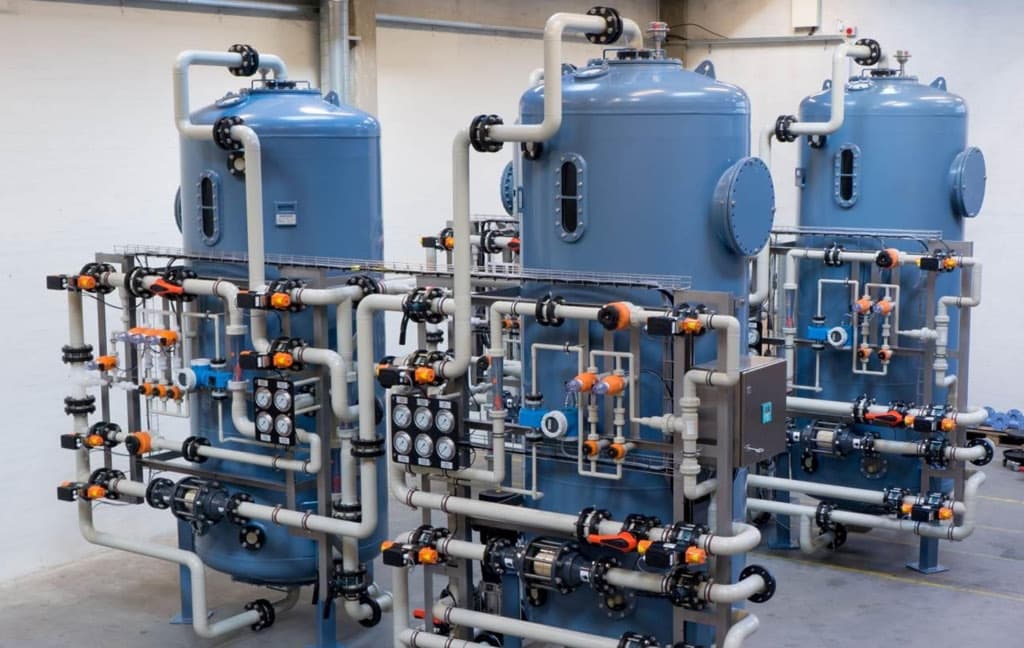
Demineralization works by retaining the cations (calcium, magnesium, sodium) and anions (chloride, sulfate, bicarbonate, silica) in the water on ion exchange resins. A unit in which cation and anion resins share the same column is called a mixed bed.

After a while the resin reaches saturation and can no longer produce water of the required quality. At that point it is regenerated with acid and caustic and made usable again.

Demineralization and Mixed Bed Systems
How it works

Stages

  1. 01

    Cation stage

    Positively charged ions exchange with the H⁺ on the resin.

  2. 02

    Anion stage

    Negatively charged ions exchange with the OH⁻ on the resin.

  3. 03

    Mixed bed polishing

    The mixed bed takes up the remaining ions and brings the outlet water to its final quality.

  4. 04

    Regeneration

    The exhausted resin is renewed with acid and caustic; the system returns to service.

Where it is used

Typical applications

  • Boiler feedwater

    Conductivity and silica control on high-pressure boilers.

  • High purity

    Demineralised water for laboratories and sensitive production lines.

  • Polishing after RO

    Removal of the ions remaining at the RO outlet.

  • Silica control

    Silica removal in the anion stage.

Regeneration chemicals are part of the job

Looking only at equipment cost when choosing a mixed bed is misleading. Acid and caustic storage, safe dosing and the discharge of regeneration waste are continuing items for the plant.

That is why, in high-flow plants, the configuration in which reverse osmosis and a mixed bed work together — with the mixed bed acting only as a polishing stage — is often more economical. We compare which configuration fits in our efficiency calculations.

Frequently asked questions

When is the resin replaced?

If outlet quality no longer holds despite regeneration and the cycle length has shortened noticeably, the resin is replaced.

How does it differ from EDI?

A mixed bed requires chemical regeneration; EDI runs continuously on electricity and needs no regeneration chemicals.

Do you replace resin in our existing columns?

Yes, we work brand-independently; resin replacement and the commissioning that follows are on us.

Send us your raw water analysis and the flow rate you need

Let us size the system together; we will survey the site in person if needed.